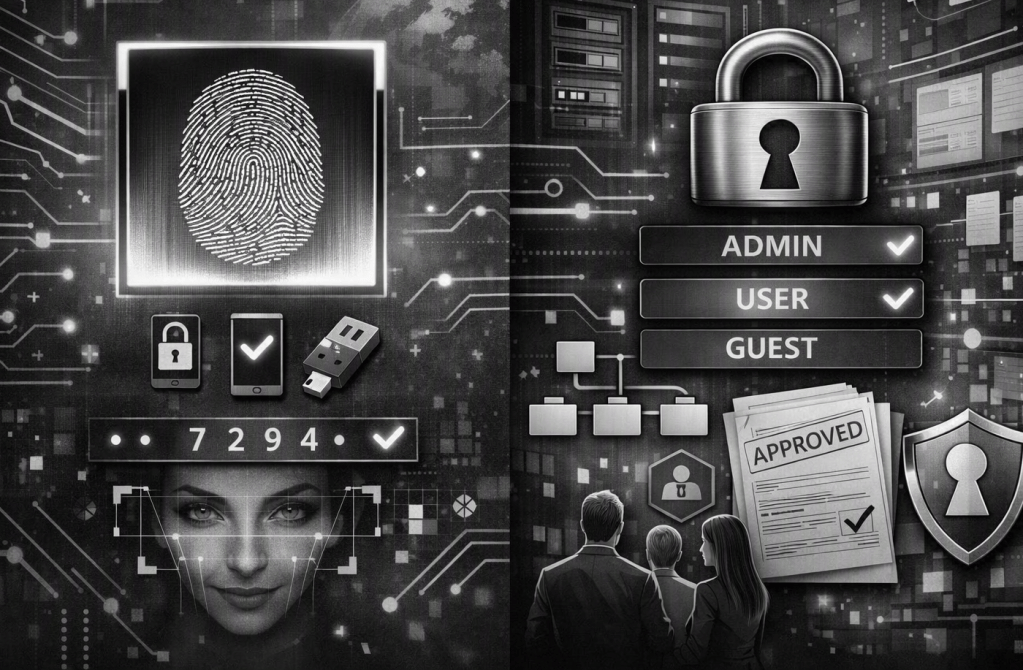
In the digital era, identity is the new perimeter.
As organisations adopt cloud services, remote work, and AI‑driven automation, two foundational concepts sit at the heart of every secure interaction: authentication and authorisation.
They are often confused, sometimes oversimplified, but never optional.
Together, they form the backbone of Identity and Access Management (IAM) and the health of a business depends on getting both right.
Authentication: Proving You Are Who You Say You Are
Authentication is the process of verifying identity. It answers one question:
“Who is this person or system?”
Modern authentication goes far beyond passwords. Businesses now rely on:
- Multi‑Factor Authentication (MFA)
- FIDO2 hardware keys
- Biometrics
- Passkeys
- Certificate‑based authentication
- Conditional access signals (device health, location, risk score)
Strong authentication protects organisations from credential theft, phishing, and impersonation still the leading cause of breaches worldwide.
Why authentication matters to a business?
- It reduces risk of account compromise
- Protects sensitive data and customer trust
- Enables secure remote and hybrid work
- Forms the foundation of Zero Trust (“never trust, always verify”)
- Ensures compliance with frameworks like Cyber Essentials, ISO 27001, and NIST
- Without reliable authentication, every other security control becomes meaningless.
Authorisation: Deciding What You’re Allowed to Do
Once identity is confirmed, authorisation determines permissions.
“Now that we know who you are, what can you access?”
Authorisation governs:
- Role‑based access (RBAC)
- Attribute‑based access (ABAC)
- Privileged access management (PAM)
- Least‑privilege policies
- Segregation of duties
- Access reviews and recertification
It ensures users only access what they need…nothing more.
Why authorisation matters to a business?
- Prevents accidental or malicious misuse of data
- Limits blast radius during a breach
- Supports compliance and auditability
- Protects critical systems from privilege escalation
- Reduces insider threat exposure
- Ensures operational clarity and accountability
Even perfect authentication cannot protect a business if authorisation is poorly designed.
Why Both Are Essential in IAM
Authentication and authorisation are not interchangeable.
They ARE interdependent.
Authentication without authorisation
You know who the user is, but they may have access to far more than they should. This leads to:
- privilege creep
- data leakage
- regulatory violations
- increased insider threat risk
Authorisation without strong authentication
You have a beautiful permission model but attackers can impersonate users and bypass it entirely.
- This leads to:
- account takeover
- ransomware entry points
- compromised admin accounts
- business‑wide disruption
IAM requires both to function
Together, they create a secure, auditable, identity‑driven environment where access is granted intentionally, not accidentally.
The Business Impact: Identity Is Now a Strategic Asset
Modern businesses rely on digital identity for:
- onboarding and offboarding
- customer experience
- supply‑chain access
- cloud adoption
- remote workforce security
- regulatory compliance
- AI‑driven automation
- operational efficiency
Because weak identity controls don’t just create security gaps, they create business risk.
Strong authentication + strong authorisation = trust, resilience, and operational confidence.
The AI Era Raises the Stakes
AI systems make millions of decisions based on identity signals. If authentication is weak or authorisation is misconfigured, AI will:
- grant access incorrectly
- automate actions for the wrong user
- expose sensitive data
- amplify existing vulnerabilities
- Identity governance becomes even more critical as AI accelerates workflows.
Authentication proves identity.
Authorisation controls access.
IAM binds them together.
Businesses that treat identity as a strategic priority. Not just a technical requirement, but building stronger security, smoother operations, and deeper trust with customers and partners.
In the AI era, identity isn’t just a security control. It’s the foundation of the entire digital business.


Leave a comment