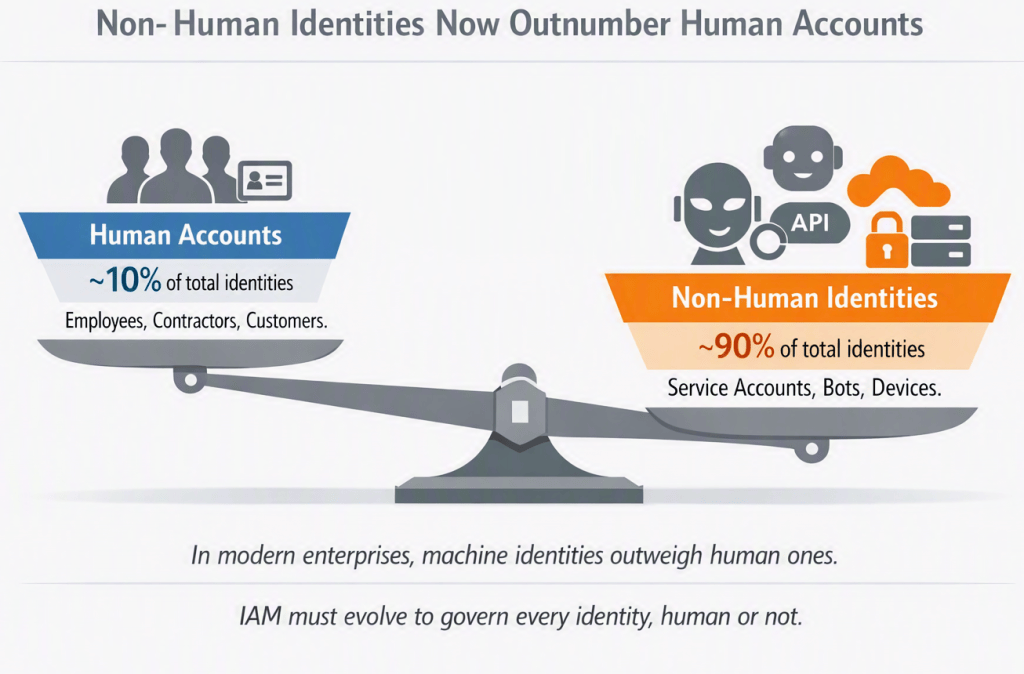
In cybersecurity, we often talk about users as if they’re all human employees, contractors, customers, or partners.
In reality, the majority of identities in many organisations are no longer human at all.
APIs, service accounts, bots, IoT devices, containers, and automated scripts now outnumber human accounts in most enterprise environments.
These non‑human identities (NHIs) are essential for automation, scalability, and integration but they often operate invisibly, without the same governance or accountability that human identities receive.
And that’s where risk begins.
Non‑human identities are digital entities that perform actions, access data, or communicate across systems without direct human interaction.
Examples include:
-Service accounts used by applications
-API keys connecting systems
-Machine identities for IoT devices
-Bots performing automated tasks
-Cloud workloads and containers
Each of these identities has permissions, credentials, and access rights just like a person.
But unlike people, they don’t clock in, change roles, or leave the organisation.
They persist quietly in the background, often forgotten.
Just like human accounts, NHIs have a lifecycle however it’s rarely managed properly.
NHI Lifecycle SHOULD be completed as follows:
Creation: A developer or system creates a service account or API key to enable automation.
↓
Use: The identity performs tasks, accesses data, and interacts with other systems.
↓
Change: Permissions evolve as systems are updated or integrated.
↓
Ownership Drift: The original creator leaves or the system changes, and no one remembers who owns the identity.
↓
Neglect: Credentials remain active long after they’re needed.
↓
Risk: Unused or ownerless identities become prime targets for attackers.
Without governance, NHIs can accumulate like digital dust… invisible, unmonitored, and dangerous.
When non‑human identities are left unmanaged, they introduce several critical risks:
–Excessive permissions: Many service accounts are created with broad access “just to make it work.”
-Credential sprawl: Hard‑coded passwords, tokens, and keys stored in scripts or repositories.
-Lack of accountability: No clear owner means no one reviews or revokes access.
-Persistence after decommissioning: Systems are retired, but their service accounts remain active.
-Exploitation: Attackers target forgotten NHIs to gain privileged access without detection.
In short, NHIs can become the shadow identities of an organisation.
Invisible but powerful.
The good news is that IAM already provides the foundation for managing NHIs, we just need to extend those principles.
1. Identity Governance for Machines
Apply the same governance rules used for people:
Define ownership for every NHI.
-Review access regularly.
-Enforce least privilege.
-Automate deprovisioning when systems are retired.
2. Authentication and Credential Hygiene
Treat machine credentials like human passwords:
-Rotate keys and tokens regularly.
-Store them securely (vaults, not code).
-Monitor usage and anomalies.
3. Privileged Access Management for NHIs
Include service accounts and APIs in PAM strategies:
-Vault credentials.
-Enforce just‑in‑time access.
-Audit privileged activity.
4. Lifecycle Automation
Integrate NHI management into DevOps and cloud workflows:
-Automate creation and deletion.
-Tag ownership and purpose.
-Link identities to systems and teams.
As organisations scale, the number of non‑human identities grows exponentially.
In cloud environments, it’s common to see 10–20 times more machine identities than human ones.
Without governance, these identities become the weakest link in the security chain.
Extending IAM to cover NHIs isn’t just a technical necessity it’s a strategic shift.
It ensures that every identity, human or not, is accountable, monitored, and governed.
In the modern enterprise, identity is no longer just about humans.
It’s about everything that acts on behalf of them.
Non‑human identities already outnumber human accounts.
They’re powerful, essential, and often invisible.
But without governance, they become silent vulnerabilities.
Extending IAM principles to NHIs lifecycle management, ownership, least privilege, and continuous monitoring, transforms them from risk into resilience.
Identity security isn’t just human anymore.

